Neural Transmission and Stroke Recovery – A Guide for Families
When a loved one experiences a stroke, families often focus on visible symptoms such as weakness, paralysis, speech difficulty, or muscle stiffness. However, these outward signs reflect deeper damage within the brain’s communication system.
Understanding neural transmission helps families:
- Set realistic expectations for recovery
- Avoid unnecessary fear or false hope
- Support rehabilitation in a more effective way
What Is Neural Transmission?
Neural transmission is how the brain communicates with the body through neurons and their connections called synapses.
- Electrical signals travel within neurons
- Chemical signals (neurotransmitters) pass between neurons
Every movement, word spoken, or swallow depends on clear and stable neural transmission.
Understanding Brain Electrical Activity
The brain functions through controlled electrical impulses known as action potentials.
When the brain sends a command—such as moving an arm—millions of neurons fire in a precise and coordinated pattern, sending signals through the spinal cord and peripheral nerves to the muscles.
Important for families to know: Electrical activity in the brain is normal. Problems arise only when signals become too weak, disorganized, or unstable after injury.
- Weak signals may cause paralysis or poor movement
- Unstable signals may cause stiffness, tremors, or involuntary movements
- Inefficient signaling increases fatigue
What Happens to the Brain After a Stroke?
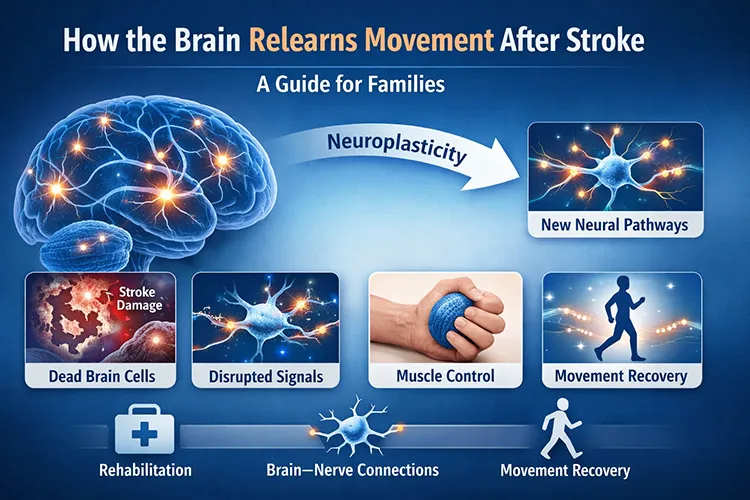
A stroke interrupts blood flow to part of the brain, depriving neurons of oxygen and nutrients.
1. Neuron death
Neurons in the core of the damaged area may die permanently and cannot regenerate.
2. Disrupted neural pathways
Surviving neurons may lose their connections, preventing messages from reaching muscles.
3. Unstable neural signaling
The brain may send inaccurate or mixed signals, resulting in poor movement control.
Key clarification: Weakness or stiffness does not always mean recovery has stopped. Often, neural signals still exist but lack stability.
How Does the Brain Recover?
Although dead neurons cannot return, the brain has a powerful ability called neuroplasticity.
- Healthy brain areas can take over lost functions
- New neural pathways can form around damaged regions
- Electrical signals can become more organized over time
This is why early, consistent, and well-guided rehabilitation is essential.
Why Signal Stability Matters More Than Muscle Strength
Muscles do not move on their own. They respond only to instructions from the brain.
- Stable signals reduce muscle stiffness and spasticity
- Accurate signals improve voluntary movement
- Efficient signaling lowers energy consumption
True recovery happens when the brain, nerves, and muscles work together again.
Guidance for Families
Stroke recovery is rarely linear. Progress may be slow and sometimes invisible.
- Be patient and realistic
- Focus on consistency rather than intensity alone
- Support brain–nerve–muscle reconnection, not just physical force
The brain can relearn—but only through appropriate, repeated, and sustained stimulation.
Final Takeaway
A stroke disrupts not only brain tissue but the entire neural communication system.
Recovery depends on restoring stable neural transmission and guiding the brain to regain control over the body.
With understanding, patience, and correct rehabilitation, meaningful recovery remains possible—even long after a stroke.